
There is no village in Bangladesh officially called Time Village. At least, not on the maps we currently use. According to those maps, such a place simply does not exist.
The name is actually my invention.
In my opinion, the village deserves to be called Time Village. Though the people who live there do not care much about names. To them, a village is simply a village.
In Time Village, time itself seems unwilling to move.
Everyone has an abundance of it.
A farmer may suddenly decide, while working in the field, that he would rather sit quietly and breathe in the autumn wind instead of continuing to weed the crops. And so he does exactly that—for hours. Eventually night falls. Jackals begin to howl in the distance.
Listening to those distant cries, a mother slowly tells her child a bedtime story. She takes her time with the story. Everything here happens slowly.
When nocturnal birds disappear into hollow tree trunks, the deep night finally arrives.
Even that night seems reluctant to pass.
After arriving here, I finally understood what a village truly is.
Time Village has everything that a village should have:
slender drumstick trees with vines wrapped around them,
water spinach growing along the banks of a canal,
clusters of swamp flowers,
bamboo groves and wild shrubs,
the sharp fragrance of roadside blossoms,
paper boats drifting down tiny streams,
and an ancient banyan tree that must be over a hundred years old.
People gather beneath that tree in the evenings to sing together.
But among all these things, the object I like the most is a boat.
It is simply a wooden boat.
No nanoblast engine.
No propulsion technology.
Yet whenever I sit in it, I lose all desire to return to the ruined world of my own time.
And strangely enough—when you sit in that boat, time seems to stop even more.
I spent the winter in Time Village not long ago.
The taste of steamed rice cakes and sweet coconut dumplings is still stored somewhere inside my neural network.
I did not bring any technology from my own time with me. So I try to remember everything the old-fashioned way—with memory.
One day the boatman Haru pushed his boat away from the riverbank, and I drifted into my thoughts.
Haru hummed a strange melody while rowing. I had never heard music like it before coming here.
It was a traditional folk song called Bhawaiya.
Listening to his song, I decided I might as well explain the world I came from.
In the Bangladesh I left behind, the year is 3054.
What year is it here in Time Village?
I have never seen a calendar.
As far as I know, I am the only scientist in my world who has ever discovered this village.
That discovery happened about a year ago.
At first, Time Village existed only as a thirty-five-digit coordinate number in my system.
In my era, Bangladesh is nothing more than a massive field of ruins. Civilization collapsed long ago.
Among those ruins, my Quantum Bubble Spectrometer detected something unusual.
A tiny black door.
At first I assumed it was a simple spatial portal.
So I stepped through it.
The next moment I found myself standing beneath a gigantic tree in the middle of heavy rain.
When I turned around—
The portal had vanished.
In front of me stretched endless rows of green trees.
That was the beginning.
Since that day, I have lived in this village.
At first I wandered around for several days without a place to stay. Eventually the villagers took me in.
Their kindness and hospitality amazed me.
And somehow, Time Village held me there.
One of the strangest things was their food system.
They do not use food printers.
They simply grow plants in soil and eat them.
And the taste!
I have never found anything like it in the Bangladesh of the year 3054.
In my time, villages do not exist.
No one even knows what a village is.
Instead we live in numbered sectors.
My home is in Sector 10-5-13.
My wife Marini and my daughter Irina are waiting for me there.
Sometimes I feel the urge to return.
But for now, I cannot find the portal again.
And truthfully, the desire to return is not yet strong enough.
Irina is now grown up.
She spends most of her time conducting research on distant planets.
Marini works in the Intergalactic Peacekeeping Committee.
I rarely even see her.
During my stay in Time Village I have learned many things.
A few days ago a farmer named Rasul Mia gave me something called palm fruit pulp.
He harvested a whole pile of them from a tree and said,
“Eat as much as you want.”
While eating, I realized that in my own world I would need to spend five thousand energy units to buy food with this kind of flavor.
That same day Sharif’s mother cooked a dish called bottle gourd with shrimp.
Even the entertainment here is unusual.
There is no virtual reality.
Everything is real.
One afternoon I went fishing with a boy named Ratan.
We caught two tiny fish using a bamboo rod.
Suddenly I felt an intense surge of happiness—as if someone had injected a powerful dose of neo-dopamine directly into my system.
Ratan shouted excitedly,
“Fish! Fish! Now dance!”
And I shouted with him.
I have gradually learned the rhythms and expressions of this place.
When rice plants dry out in late autumn, farmers stack the straw into tall piles.
I once called those stacks “the guardians of autumn.”
The villagers laughed.
They often ask me,
“Brother, what kind of world do you come from?”
I cannot explain to them what kind of time I came from.
Time does pass in Time Village.
But at what speed—it is impossible to tell.
My calculations suggest something strange.
Even if eternity passed here, it might equal only a few moments in my own timeline.
I became good friends with Ratan.
The boy laughs constantly, though I have no idea why.
One day we tried catching dragonflies together.
I failed to catch even one.
“Ratan,” I asked him, “what lies beyond this village?”
“I don’t know,” he replied. “Nothing.”
“What do you mean nothing? Is the village floating in space or something?”
“Maybe,” he shrugged.
“Let’s walk and see what’s at the edge.”
“I can’t. My mother will beat me.”
“She won’t. I’m with you.”
“Alright then. But we must return before sunset.”
We walked for a long time.
Eventually I noticed something strange.
We had returned to the same rice field where we started.
Exactly the same place.
It was like a miniature black hole.
The entire space here seemed to be curved.
Perhaps that is why time behaves so strangely in this village.
Ratan suddenly said nervously,
“I told you. Ghosts trapped us. Every time you walk, you come back here again.”
“There’s an old room near Kashinath Temple,” he continued. “People say a ghost lives there. Anyone who goes inside never returns.”
That night I believed in ghosts with absolute conviction.
Later, inside my hut, a small oil lamp flickered.
Shadows danced along the walls.
I sat watching those shadows and thinking.
Suddenly a shadow appeared at the door.
“Uncle, are you sleeping? It’s me, Ratan.”
“Ratan? At this hour?”
“Sometimes I go out at night… to look for ghosts.”
“Where will you find ghosts?”
“Let’s go to Kashinath Temple.”
Once again I felt that strange irresistible pull.
This time I carried my briefcase.
Inside it was my Quantum Bubble device.
We walked through the dark fields.
Jackals watched us with glowing eyes.
An owl twisted its neck to stare as we passed the village pond.
Ratan picked up fallen fruits along the way—persimmons, guavas, and other strange local fruits.
We ate them as we walked.
After almost an hour we reached the temple.
The courtyard was overgrown with jungle.
At the end stood a heavy wooden door.
Was I afraid?
I had completed countless intergalactic missions.
Yet now I stood trembling before a ruined building, frightened of ghosts.
If Marini or Irina heard about this, they would probably demand a brain reboot.
No.
I did not want that.
A reboot might erase my memories of this place.
And I wanted to preserve this strange fear.
The door creaked open.
Inside was darkness.
Then my Quantum Bubble Spectrometer began to beep.
There was an anomaly here.
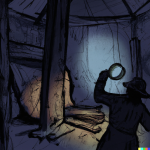
I lifted the lantern.
Ahead stood another heavy door that had clearly not been opened for years.
I pushed it open.
And there it was.
Exactly what I expected.
In one corner of the room floated a round, smoky black shape.
A door made of darkness.
“Don’t go in!” Ratan shouted.
“That’s the ghost door!”
But I already understood.
This was the lost portal.
Would I ever return to Time Village again?
As I stepped closer, faint sounds reached my ears—like a distant radio broadcast.
It was Irina’s voice.
She was telling someone,
“If necessary, I will search even the Drakuna Galaxy to find my father.”
I knew that galaxy was full of dangerous criminal species.
Hearing the fear in my daughter’s voice, I could not stay away any longer.
I turned toward Ratan and smiled.
“It’s alright,” I told him.
“This ghost is a good ghost.”
From my briefcase I took out a diary.
I had written it over the past year.
It contained stories of my world.
One day, when Ratan grows up, he may read it and understand.
And if he never understands—that is fine too.
Not everything must be understood.
Then I stepped into the black smoke.
As I disappeared, I imagined the villagers gathering at the pond during sunset.
They would talk about the mysterious traveler who vanished.
Maybe someone would believe Ratan’s story.
Or maybe Ratan would never tell anyone about the strange midnight adventure at all.
Related posts:
 সায়েন্স ফিকশন উপন্যাস : মায়াদ্বীপ ২৩৯০
 Exploring the Universe of Zafar Iqbal’s Science Fiction: Free Downloads Await!
 সায়েন্স ফিকশন গল্প : সময়পুর
 সায়েন্স ফিকশন গল্প : বিরিন্তা
 A Long Morning : A dark and noir science fiction story
 Ratan’s Diary
 The Ninth-Dimensional Gobot : A sci-fi comedy story
 Ethan : A Mystery Science Fiction Thriller Story
 ধ্রুব নীলের অতিপ্রাকৃতিক গল্প : গোরখোদক
 রোমান্টিক হরর গল্প : দম্পতি
 তৈয়ব আখন্দ ঘড়িবিতান
 সায়েন্স ফিকশন গল্প টিম্ভুত
 হুমায়ূন আহমেদের সেরা বই | রইল ১০টি বইয়ের রিভিউ
 সায়েন্স ফিকশন গল্প : এখন কিংবা…
 অতিপ্রাকৃত ছোটগল্প: দৌড়
 প্রেমের গল্প : মালতী
 রোমান্টিক কমেডি নাটকের চিত্রনাট্য : নীল চকোলেট (স্ক্রিপ্ট)
 1899: A Dream Adrift on Myth, Memory, and the Maze of Time
 হৃদয়ের যত্ন নিও
 ডিম নিয়ে এলাহিকাণ্ড